Interview:
Inside Japan Selection
Nuthmique — Tales of the Elsewhere Islands

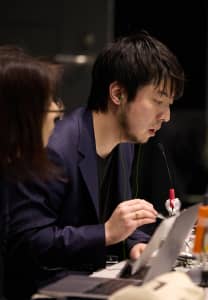
Nuthmique is a theatre company led by composer, playwright, and director Masashi Nukata, whose work is defined by its strong musical foundation. By creating theatre through compositional methods, the company explores the boundary between music and theatre, developing a unique theatrical expression that has earned recognition in Japan.
Its latest production, Tales of the Elsewhere Islands, is a music drama that reconstructs the relationship between theatre and music through language and voice. Actors, singers, and musicians share the same performance space, where singing, instrumental performance, and spoken text flow seamlessly into one another.
Language and voice as musical elements in theatre

Premiered in 2025, Tales of the Elsewhere Islands places actors alongside guitar, bass, and drums onstage. Throughout the performance, live music intertwines with rap-like narration and song meets dialogue, creating a unique perspective towards death.
The work is a part of Nukata’s ongoing artistic exploration of the theme of suicide, which has appeared throughout his recent creations. The story begins when watashi (I) visits a shoreline to mourn their father. A woman appears, claiming that she recognises the view, and starts recounting the events from thousands of years ago. As various figures emerge from the memories, people and events that should never have met, begin to intersect within memory.
The uniqueness of the production lies in how the music is found within the language and voice, a distinctively different approach compared to musicals and operas. The sounds of spoken Japanese are therefore fundamental components of the composition, and the work is presented as a Japanese-language music drama.
However, the crucial point is not the use of Japanese itself. Rather, it is the capacity of a language’s rhythm, intonation, and semantic associations to generate imaginative leaps in the audience’s perception. Nukata believes that even when performed in another language, music can preserve and communicate the original linguistic sensations.
A simple greeting such as “Hello,” for example, can sound entirely different depending on how it’s pronounced or stressed. It is similar to how melody and rhythm can transform songs or rap. The production also projects subtitles, providing linguistic stimulation through both hearing and sight, allowing audiences to experience language as a physical sensation.
Because the work overlays music onto the indirectness and ambiguous characteristic of Japanese communication, each translation of the production would naturally introduce its own cultural nuances. The musicality inherent in language itself may be universally shared, but the company sees particular affinity with English. Britain possesses a theatrical tradition, from Shakespeare to Sarah Kane, in which dramatic progression is driven by the rhythm of language. This resonates strongly with Nuthmique’s own practice, where rhythm within text forms the structural basis of performance. Tales of the Elsewhere Islands is one product of this artistic pursuit.
Crossing between music, theatre, and other disciplines
Nuthmique was founded in 2016 when Nukata’s graduation project, The City Thereafter, attracted the attention of theatre critics.
Since then, the company has consistently employed compositional methods to create theatre, investigating the relationship between music and dramatic performance. Over the past five years, performances have expanded beyond theatres, to Tokyo parks, rowing venues, and other unconventional sites. More recently, however, the company has begun returning its focus to the theatre itself as a performative space. Nukata has received a Director Award for The Glass Menagerie and been nominated for the Kishida Kunio Drama Award. He is regarded as a pioneer of theatre combining music and drama.
The company’s first work, The City Thereafter, was staged as a “musical drama without music.” It remains Nuthmique’s artistic point of departure and the conceptual predecessor to Tales of the Elsewhere Islands. Though technically modest, it sought to construct theatre solely through the musicality of language, employing repetition and subtle variation reminiscent of minimalist music to evoke urban landscapes through performance. No instruments were used, yet the work established the foundations of the company’s current artistic language. It received the Grand Prize at the 16th AAF Drama Award.
Producer Kawano recalls:
“Having studied music myself, I was fascinated by the way words were arranged as though composing a piece of music. Even without extensive knowledge of theatre, I found myself instinctively drawn to it.”
Building upon this methodology, Nuthmique has continued producing performances across diverse environments while collaborating with artists from a wide range of disciplines, including musicians, architects, sound artists, and singers. SUPERHUMAN, first staged in 2018 in an intimate venue with an audience capacity of around eighty, was recreated in 2022 as an outdoor performance in a space overlooking Tokyo Tower. The work demonstrated both its adaptability across radically different spaces and its collaborative nature, bringing together actors, dancers, and musicians. In 2024, Toward the End of the Sober Island was co-created with the artist group 2.5 architects. Set at the watersports venue built for the Tokyo 2020 Olympic Games, the project combined a drive through the area and an outdoor performance across two kilometres. By allowing the driving tour and the outdoor performance to intersect, the production invited audiences to engage directly with Tokyo’s history and contemporary environmental concerns.
After An Adventure that Lasts Forever in January 2025, Nuthmique officially defined its works as music drama.
Kawano explains:
“Nuthmique proposes another way music can function within Japanese theatre. Through theatre, we are also questioning the possibilities of music itself. Last year, we encountered the concept of ‘sound dramaturgy’ at a forum in SPAF (Seoul Performing Arts Festival). The theory on how music interacts with the work and the audience, and how it creates meaning, is exactly what Nuthmique has been exploring. We hope to meet artists around the world who share these interests.”
One of Nuthmique’s defining characteristics lies in Nukata’s simultaneous roles as playwright, composer, and director. This enables literature and musical composition to evolve together while drawing upon minimalist music traditions. The resulting works retain dramatic narrative despite belonging firmly within postdramatic theatre, embodying a contemporary understanding of music drama. Reflecting on his creative interests, Nukata notes that music within Japanese fringe theatre has historically tended to function merely as background music, and actors usually do not have a certification or institutional training on these things. “Japanese theatre has historically accepted almost anything. It would be interesting to see how music from an academic perspective can affect them.”
How can music be as effective as words?
Throughout its history, Nuthmique has challenged conventional ideas of theatre through methods made possible by Nukata’s background as a composer. Building upon these techniques, the company now seeks new international collaborations. In Europe, Nuthmique hopes to work with artists interested in developing shared approaches to directing and devising that connect with the rhythmic qualities of English. Across Asia, drawing upon previous collaborations with Filipino, Indonesian, and Korean artists, the company hopes to explore collective creation centred on urban history, cultural memory, dramaturgy, and language.
Nukata’s current artistic question is straightforward yet profound: How can musical expression possess the same communicative power as language?
Rather than treating music merely as accompaniment or song, he seeks forms in which music itself becomes a vehicle of meaning. Inspired by works such as Steve Reich’s Different Trains, he aims to create performances where music and language merge in ways that allow theatre to reach beyond the walls of the auditorium and engage directly with the outside world.
As music is now embedded within the dramatic text itself, audiences interested primarily in theatre have also begun engaging with Nuthmique’s work. Yet there are still few critics or scholars in Japan equipped to discuss the company’s methods from both theatrical and musical perspectives. The company therefore seeks opportunities for dialogue, criticism, and exchange that focus on its compositional structures and its finished productions. As Nuthmique expands internationally, it hopes to encounter collaborators, critics, and audiences capable of engaging with its work through the dual lenses of music and theatre.
Original Text by Momoko Kawano
Translated by SOIL Team