Interview:
Inside Japan Selection
SPAC – Shizuoka Performing Arts Center — Hamlet

From Japan to the world, theatre as accessible entertainment
SPAC (Shizuoka Performing Arts Center) is a publicly funded cultural organisation in Shizuoka. While most of its activities are in Shizuoka, SPAC has also established an outstanding international reputation as a theatre company.
Most of SPAC’s past overseas productions have been directed by General Artistic Director Satoshi Miyagi. Hamlet, which premiered in 2025, marked a new chapter for the company as its first collaboration with playwright and director Kumiko Ueda, who spent her early director years at the highly acclaimed Takarazuka Revue. In this production, she offers a daring reinterpretation of Hamlet through the perspective of Ophelia, the protagonist’s late lover. The show attracted widespread attention for its possibilities in theatrical expression.
Hamlet through a non-human perspective
Actors portraying Shakespeare’s familiar characters and actors that embody the perceptions of plants and animals stand together on a stage that is covered with a plastic sheet. Women (Ophelia in particular), gravediggers, and travelling performers, who have long been pushed to the margins of a society that privileges language and logic, are brought vividly to life. They are seen in contrast to Hamlet and Horatio, who think and reason through words.
At first, audiences may feel they are witnessing a feminist “revenge of Ophelia,” in which a woman who was never allowed to speak finally finds her own voice. Gradually, however, they begin to experience the world through Ophelia’s death beneath the water. The audience feels as though they themselves are part of nature. Ultimately, the production questions the relationship between humanity and the natural world.
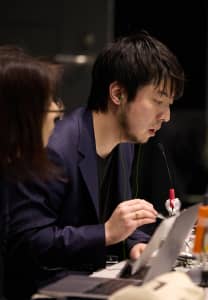
Producer Ema Murakami explains:
“Throughout the performance, the human story unfolds simultaneously with the perspectives of non-human life, expressed physically by the actors. Shakespeare’s Hamlet reflects modern subjectivity and Christian values. However, in this version, it is overlaid with a distinctly Japanese perspective of animism, where nature and humanity intermingle and change. The escape from a human supremacy worldview is what makes the show so unique and riveting.
The second major part of the story is the criticism towards intellectual supremacy which has been expressed through logic and language. It shows a contemporary society that has reached an impasse after centuries of logic and reason; a parallel with the original Hamlet, set between the medieval and the modern worlds. In Shakespeare’s original, Ophelia’s life is governed by her father’s words. In this production, she speaks the words written by Kumiko Ueda. In Hamlet, the men attempt to be logical and reasonable. Power struggles occur because each person does not allow the other to challenge their autonomy. This ultimately leads to the deaths of everyone except Horatio. After the fall of the Danish royal family, the Prince of Norway Fortinbras, arrives to close the play. In this adaptation, however, the ending is radically reimagined. Ophelia, who has been denied a voice throughout, returns as Fortinbras. The dead, and Horatio, are absorbed into the cycles of nature. The overwhelming force of the natural world, whose terror, tolerance, and beauty exists beyond the reach of human reason, is the core of the work. It is a cosmos that is so immense and complex that it defies words.”
This production is made possible by SPAC’s ensemble of actors, who share a training methodology. They are skilled in collectively embodying entities such as the gods and mythical creatures in Greek tragedy. A single performer can play multiple roles, or several actors could collectively portray a single being. One technique is relay dialogue, where multiple actors pass one phrase, or even one syllable at a time. Building on these techniques, actors discussed what it means to surrender themselves to the perspective of non-human beings that Ueda proposes. For example, it was the actors themselves who proposed to perform Hamlet’s famous soliloquy with relay dialogue. By fragmenting Hamlet’s language itself, it became possible to portray how the words that he clings to are dismantled.
The perspective of women is a vital part of this production. Ueda focuses on the fact that, although Ophelia is central to the plot of Hamlet, she is rarely allowed to express her own thoughts or desires. While Hamlet and the men around him approach the world through reason, seeking to distinguish themselves from nature and elevate humanity, the “mad” Ophelia is far removed from rationality. She does not resist becoming part of nature, ultimately dissolving into the water in death. Ueda interprets her as an antithesis to Hamlet’s worldview, or even as an anarchic presence. Although the work does not present men and women as a simplistic binary opposition, the relationship between Hamlet (the men) and Ophelia (the women) inevitably resonates with the position of women in contemporary society, where they are often expected to engage with men on equal terms by adopting systems and values, historically established by men.
Despite its seemingly complex structure, the production received an overwhelmingly positive response from a broad audience, including many junior and senior high school students regardless of their theatrical experience. There is a strong comedic emphasis, making it enjoyable even for first-time audiences. Actors also appear before the show, and even come down to the seats.
Ueda aims to bridge artistic experimentation and popular accessibility. Her productions are entertaining, but they are also supported by a profound directing philosophy and an extraordinary range of theatrical techniques. Even before the Hamlet production, she had conducted workshops exploring how animals and other living beings perceive the world. This production represents one outcome of that continuing artistic inquiry.”
A public theatre with an exceptional creative environment and achievements
Located approximately two hours by bullet train from Tokyo, Shizuoka is a regional city surrounded by nature. It is the only publicly funded theatre in Japan where actors, technicians, and producers work throughout the year, creating an exceptionally stable environment for artistic creation.
SPAC began its activities in 1997 under its founding General Artistic Director Tadashi Suzuki. Since 2007, the company has been led by Satoshi Miyagi. SPAC has extensive experience in international collaboration and touring. Productions have been presented throughout Greece, Russia, France, Italy, the United States, Colombia, China, South Korea, and other countries. Among its best-known international projects is Antigone, which opened the Festival d’Avignon.
The company regularly develops co-productions bringing together international artists and SPAC’s resident theatre troupe. Every May, it also hosts an international performing arts festival that attracts theatre fans and professionals from around the globe. In order to make world-class theatre more widely accessible, SPAC hosts performances for secondary-school students, training programmes, and outreach activities.
Last year, playwright Natsuki Ishigami joined SPAC as Artistic Director. New projects, such as community-based artistic research and collaborations with Southeast Asian playwrights have begun. Recent productions include Eel Migration, developed through conversations with Brazilian communities living in western Shizuoka, and a dance work inspired by the wrongful conviction of Iwao Hakamata. These projects aim to spark discussion.
SPAC’s actors train using both Suzuki’s method of actor training and Satoshi Miyagi’s training, providing them with a shared knowledge that enables collaboration with directors from around the world. This version of Hamlet could be created because the actors live close to nature with forests and animals surrounding them. SPAC’s system itself, where technical staff work alongside performers throughout the rehearsal process is another unique trait that contributed to the creative process.
The era of international collaboration with diverse artists
Until now, SPAC’s international touring has centred primarily on Satoshi Miyagi’s works. SPAC now hopes to introduce and tour works by a wider range of artists.
Hamlet aims for production throughout Europe, with future opportunities in Southeast Asia and North America also under consideration. Outdoor performances would be ideal since it can contribute to dissolving the boundaries between nature and human society.
After gaining further experience in international touring, SPAC hopes to produce works with a diverse team of Japanese and international directors.
Murakami concludes:
“With resident actors, technical staff, and a dedicated theatre, SPAC has a creative environment unlike any other theatre in Japan. We want to use that environment to build pathways through which artists can travel directly from a regional city to the international stage, without having to pass through Tokyo. As a public theatre, we also hope to build partnerships with educational organisations and people working on social issues, and developing artist residencies like exchange programs. Our goal is not simply to buy and sell performances, but to cultivate long-term artistic collaboration.”
Original Text by Momoko Kawano
Translated by SOIL Team